Search This Blog

Monday, March 25, 2019

When Forever Doesn't Mean Forever.


God sends an unnamed prophet to pronounce judgment on the house of Eli, namely the tribe of Levi. As the result of Eli’s irresponsible parenting of his sons and because of their (Hophni and Phinehas’) scandalous sins, God chooses to remove the line of Eli from the priesthood.  He also promises to raise up a lasting priesthood.

These two sons and their atrocious evils as so-called priests are summarized in this passage.  They are condemned for their “scorn” of God’s sacrifices and offerings; and by fattening themselves by stealing the best offerings.  Now here we have two interesting facets of God’s judgment.

A. God was not unaware of His previous promise.  I promised that your house and the house of your father should go in and out before me forever.”   Notice the word “forever”.   This is the Hebrew word עלם ̀ [olam].[1] It indeed can mean ‘forever’ or everlasting, evermore, or for a long duration.  The sons of Levi, and in particular Aaron were granted the priesthood “forever” (see Exodus 27:21; 29:9).  Now every Christian would affirm the inerrant Word of God and in particular the literal and plain reading of the text.  Forever is forever.

But now the Lord declares: ‘Far be it from me, for those who honor me I will honor, and those who despise me shall be lightly esteemed.’”[2]  We all understand the logic, but it is still mystifying why God would make an eternal promise that is not eternal.  On the surface this is troubling to the faith of any sincere believer.  If forever doesn’t mean forever, does this impinge on God’s trustworthiness?

The fact is that the English word “forever” does not mean that.  Note for example:

In the Old Testament the old covenant of the law is referred to as the "everlasting covenant" (Leviticus 24:8). But the New Testament records that the first covenant was "done away" and "abolished" 2 Corinthians 3:11,13.   As in this story, the Aaronic priesthood is spoken of as "an everlasting priesthood" Exodus 40:15.   Yet Hebrews7:14-18 declares an end to the Aaronic priesthood and a new priesthood after the order of Melchizedek.  

Israel was to "observe the Sabbath throughout their generations, for a perpetual covenant" (Exodus 31:16).   Jonah was not in the fish’s belly "forever" Jonah 2:6. A bond slave could not possibly serve his master "forever" Exodus 21:6. God did not dwell in Solomon’s temple "forever" 1 Kings 8:13.

A very significant promise in the Old Testament is this: And you made your people Israel to be your people forever, and you, O Lord, became their God. And now, O Lord, let the word that you have spoken concerning your servant and concerning his house be established forever, and do as you have spoken,” (1 Chronicles 17:22–23, ESV).  But we see very clearly that forever is not forever, for even this promise is grounded conditionally. “Now therefore, if you will indeed obey my voice and keep my covenant, you shall be my treasured possession among all peoples, for all the earth is mine;” (Exodus 19:5, ESV).  

I think these are sufficient examples to show that in essence, forever, means the period of time that fulfills God’s plan.  God is not hostage to the English language.

B.  God ordains another priest, forever.  We read, And I will raise up for myself a faithful priest, who shall do according to what is in my heart and in my mind. And I will build him a sure house, and he shall go in and out before my anointed forever.” (1 Samuel 2:35, ESV) This could be speaking of Samuel as the fulfillment of that promise, but Samuel’s sons did not continue in his faithful ways.  Most commentators think it refers to Zadok, the high priest in the time of David (2 Samuel 8:17). Zadok was a descendant of Aaron and a leader over his family of Levites (1 Chronicles 27:17).  Zadok remained faithful to Solomon and was rewarded.  However we have already noted that the Aaronic priesthood did come to an end.

Is it possible that God had another house, another priest in mind when he made such a promise in 1 Samuel 2:35.  I think he did.  “Both Samuel and Zadok, according to most commentators, should be considered only partial fulfillments of the prophecy. Jesus Christ Himself is the final and ultimate fulfillment of the faithful priest; He is the true and eternal High Priest.”[3]  Although I disagree with MacArthur regarding the so-called future Millennium, even his dispensationalism admits that “This refers to the messiah who will defeat God’s enemies and establish His rule.”[4]

The judgment of God on Eli’s house corresponded to their sin.  They had fattened themselves by stealing the best from the Lord’s offerings, but they are left begging for even a morsel of bread.

God’s Word is the final authority on all matters of doctrine and truth.  It is complete.  It is unified and coherent.  If forever doesn’t always mean forever, but sometimes it does, how do we know the difference?  Answer: the Bible tells me so.   That which God has not rendered obsolete by His Word is indeed forever.  Israel, the Aaronic priesthood, etc. have been superseded by a better Priest and a better Israel.  We enjoy the priesthood and the reign of the inimitable son of David, the Lord Jesus Christ.


[1] (1996). Hebrew Dictionary (electronic ed., p. 2). Escondido, CA: Ephesians Four Group.
[2] The Holy Bible: English Standard Version. (2016). (1 Sa 2:30). Wheaton, IL: Crossway Bibles.
[3] Hindson, E. E., & Kroll, W. M. (Eds.). (1994). KJV Bible Commentary (p. 539). Nashville: Thomas Nelson.
[4] MacArthur, J., Jr. (Ed.). (1997). The MacArthur Study Bible (electronic ed., p. 381). Nashville, TN: Word Pub.

Friday, March 15, 2019

7000 People Groups Have No Access to the Gospel


Last night I listened to David Platt at the 2019 G3 Conference, speaking on the topic of Unreached People.  This stirring message identified from 5000 to 7000 people groups who have, to date, no access to the Gospel.  One tool that western Christians can use is produced by the Joshua Project.  It is an app called Unreached of the Day.  It’s a free download. 

Today (March 15, 2019), for instance you can pray for the Gadaria peoples in India.  Among this group there are no Christians. 


Every day the app takes you to a new group to pray for.  Let me encourage you to start today.  “And Jesus came and said to them, “All authority in heaven and on earth has been given to me. Go therefore and make disciples of all nations, baptizing them in the name of the Father and of the Son and of the Holy Spirit, teaching them to observe all that I have commanded you. And behold, I am with you always, to the end of the age.”” (Matthew 28:18–20, ESV)


Thursday, March 14, 2019

Deliberate, Decisive and Deathly - 1 Samuel, Part 7


It is common knowledge that Eli’s sons were openly sinning.  Previously we have seen the horror of their sin in the treatment of God’s offering (1 Samuel 2:12ff)).  Now their transgression is increased by their immorality.  They were having sexual relations with women “at the entrance to the tent of meeting”. “This is obviously intended to show the incredible degeneration of the worship of Jehovah in Israel. Whether this is cultic prostitution, as was practiced in other Canaanite religions, or simply fornication is academic and relatively unimportant. The point is that the depth of this willful, flagrant, and unforgivable sin was appalling.”[1]  As noted in Exodus 38:8, these may have even been women who served in the Tabernacle.

Eli rebukes his sons for their sinful behavior and tries to reason with them: “If someone sins against a man, God will mediate for him, but if someone sins against the Lord, who can intercede for him?”[2] This is a very interesting approach.   Some think that he’s saying, “If God would surely judge when one sinned against another man, how much more would He bring judgment against those who sinned against Him.”[3] That does not appear to be what Eli says.  He clearly says, “If someone sins against the Lord, who can intercede for him?”[4]  It is more reasonable to assume that Eli is reminding these men that they are intercessors; they are mediators.  If they transgress, if they openly sin, who is it that can mediate between them and God?  No one!  It’s a weak theological argument at best, for God had anticipated the need for the priests to be cleansed.  The author of Hebrews, writing of Jesus, writes, He has no need, like those high priests, to offer sacrifices daily, first for his own sins and then for those of the people, since he did this once for all when he offered up himself.” (Hebrews 7:27, ESV)


The result of Eli’s plea falls on deaf ears.  The author’s point is profound, to say the least.  “For it was the will of the Lord to put them to death.”[5]  Let’s grasp this clearly.  The inspired author is asserting that these men did not and could not repent for it was God’s will to kill them.  “When God is determined to destroy, no human intercession is effective. For the writers of the Bible, the fact that divine providence and human character mingle means that destinies are regarded as ultimately the result of the divine will.”[6]  God’s determination to take their life, having been already determined could not be thwarted. This is called, in theology, “judicial hardening”. 

Judicial hardening is a clear and repeated concept in the Bible.  It is God’s active, determinative, choice to blind and bind an already rebellious, calcitrant defiant person in their rebellion that results in an inability to repent and be saved. (Example: Esau[7])  One should note that in every case (e.g. Pharaoh) that it is God’s purpose to bring to pass a greater redemptive purpose through this hardening. For my discussion on Pharaoh you can read my Blog HERE.  In that Blog I write,

“When God is said to "harden" the heart of a person, He is acting in divine justice.  Paul has already stated in Romans 1 that God's justice on the unrepentant human race is that "God gave them up."[2] I suggest that this act of justice is also called in Scriptures as "God hardening."  The end result is that those to whom God does not show mercy, He extends justice and that justice is leaving man in his own sin and rebellion resulting in a hardened heart.”

This is a warning if you the reader are not in Christ.   The inimitable John Owen wrote, “No one knows where deliberate sin may lead.”[8]  But the Divine Author also encourages us in this text: “Now the boy Samuel continued to grow both in stature and in favor with the Lord and also with man.” (1 Samuel 2:26, ESV). “God’s grace is his own; he denied it to the sons of the high priest and gave it to the child of an obscure country Levite.”[9]


[1] Hindson, E. E., & Kroll, W. M. (Eds.). (1994). KJV Bible Commentary (p. 537). Nashville: Thomas Nelson.
[2] The Holy Bible: English Standard Version. (2016). (1 Sa 2:25). Wheaton, IL: Crossway Bibles.
[3] MacArthur, J., Jr. (Ed.). (1997). The MacArthur Study Bible (electronic ed., p. 380). Nashville, TN: Word Pub.
[4] The Holy Bible: English Standard Version. (2016). (1 Sa 2:25). Wheaton, IL: Crossway Bibles.
[5] The Holy Bible: English Standard Version. (2016). (1 Sa 2:25). Wheaton, IL: Crossway Bibles.
[6] Crossway Bibles. (2008). The ESV Study Bible (p. 495). Wheaton, IL: Crossway Bibles.
[7]See to it that no one fails to obtain the grace of God; that no “root of bitterness” springs up and causes trouble, and by it many become defiled; that no one is sexually immoral or unholy like Esau, who sold his birthright for a single meal. For you know that afterward, when he desired to inherit the blessing, he was rejected, for he found no chance to repent, though he sought it with tears.” (Hebrews 12:15–17, ESV)

[8] https://www.ligonier.org/learn/devotionals/no-chance-repent/

Saturday, March 2, 2019

A Better Way To Look At Your Time Demands


Over the years, I have taken a lot of time management courses.  I even did a seminary level course on leadership that included a lot of study on the topic.  This is by far more insightful and helpful than anything I’ve ever studied.

Your life is simply not a list of priorities but rather the coming together of three inescapable dimensions of calling. You are called to relationships, you are called to work, and you are called to God. Each of these is a significant expression of how God calls every one of us to live. In a way, none of them is more important than the other since each exists because of divine calling. So rather than a list, you have three intersecting, overlapping domains of godly living: the social domain, the labor domain, and the spiritual domain (although everything is spiritual). Think of these as a triad of overlapping circles, where each circle connects with the other two.


Yet you have a limited amount of time to devote to these domains—24 hours in a day, 7 days in a week, 30 days in a month, and 365 days in a year. So if one activity expands over a longer span of time, it can only expand because you have contracted the duration of another activity. Almost no one says, “Work is a greater priority to me than family, so I am going to put family lower on my list.” Rather, the demands of work gradually begin to gobble up more and more of my time, and as they do, because I don’t have limitless time, I am left with less time for my family. Few believers would say that work is more important than their relationships with God and his people, but their life of work expands to the point where they have little time left to do anything but casually attend the church to which they once committed themselves. It is impossible for one area of my calling to expand without it causing other areas of equally important calling to contract. So it’s important to ask not what your priorities are but if your world of work has expanded to the point that it has caused a harmful contraction of your time with your family and your pursuit of God? This seems to me to be a much more helpful way of thinking about the schedule tensions that so many of us experience when it comes to work, family, and church.[1]

We do still think in some sort of “priority” management or triage.   The issue is, for instance, if my work starts to crowd out my recreation time, then the impact isn’t that serious.  But if work, or family, or whatever squeezes out my relationship with Christ or the Church, there are serious consequences.

The final word to Dr. Tripp: "God is too wise and loving ever to call you to one area of responsibility that will necessitate you being irresponsible in another."


[1] Tripp, P. D. (2015). Awe: why it matters for everything we think, say, and do. Wheaton, IL: Crossway.

Thursday, February 28, 2019

Low Expectations of Teens - 1 Samuel, Part 6


This passage has two bookends:

& Samuel was ministering before the Lord, a boy clothed with a linen ephod.” (1 Samuel 2:18, ESV)

& . . . the boy Samuel grew in the presence of the Lord.” (1 Samuel 2:21, ESV)

The linen ephod was likely a garment that identified him as one working in the priesthood.  In verse 11 when he was left by his parents with Samuel, we learn that he served “. . . in the presence of Eli the priest” (1 Samuel 2:11b, ESV).  
Now Samuel was serving “in the presence of the Lord.”[1]

This idea of the “presence of the Lord” is significant to the Bible and to the Christian life.  My cover photo on my Facebook page shows the Latin phrase: Coram Deo, which means “living in the presence of God, under the authority of God, to the glory of God.

We must agree that God is everywhere (Psalm 139:7-8); but at the same time, He chooses to reveal or manifest His presence in localized and intense ways (e.g., Exodus 3:2).  Likewise, the Believer can be assured of God’s continual presence (Hebrews 13:5).  There will be a day when Christians experience God’s unveiled presence (1 John 3:2). 

 “The narrator's description of Samuel's continued growth in the Lord's presence (v.21), as well as in stature and in favor with God and men (v.26), is echoed in Luke's portrayal of Jesus' youth (Luke 2:40, 52).”[2]  It is interesting to me that the author is so clear: “Samuel grew in the presence of the Lord.”  It is speculative but we tend to think of Samuel as a young man, maybe a teen.  Josephus, the Jewish historian though Samuel was about 11 years old. 

Consider the young people you know.  How many, as young teens, could it be said of: they are serving the Lord and growing in His presence?  This is stunning.  Have we expected too little of our young people?  Cameron Cole writes,

“People have very low expectations for teenagers in the Christian context and it’s absurd. We have such high expectations for kids in terms of school—kids are learning foreign languages, taking college-level physics, and holding important leadership roles, like being team captains or leading service projects. And yet in the church, we regard teenagers like they’re toddlers. I think we need to elevate our expectation of what kids can actually do in a church.”[3]

Several years ago I attended a conference where the authors, Alex and Brett Harris spoke on their book: Do the Hard Things.  I later listened to their book on audio.  Alex said, “The teen years are some of the most valuable years of our lives in terms of developing a purposeful mindset and preparing for the future.” “The ‘do hard things’ message is uniquely needed there, because teens are subject to our society’s lowest and most damaging expectations.”  

As the years would pass, Brett’s life became harder. You can read about it HERE.  By God’s grace, by not succumbing to the low expectations as a teen, Brett exceed all expectations as a husband.

Perhaps we need to rethink our expectations of young people.


[1] The Holy Bible: English Standard Version. (2016). (1 Sa 2:21). Wheaton, IL: Crossway Bibles.
[2] Expositor's Bible Commentary, The, Pradis CD-ROM:1 and 2 Samuel/Exposition of First Samuel/I. Prelude to Monarchy in Israel (1:1-7:17)/A. The Childhood of Samuel (1:1-4:1a)/3. The wicked sons of Eli (2:12-26), Book Version: 4.0.2
[3] https://corechristianity.com/resource-library/articles/why-our-expectations-for-teens-in-the-church-are-way-too-low

Monday, February 11, 2019

The Sovereign Call of God - 1 Samuel, Part 5


What was happening in this story?  First, we are told that Eli’s sons took a three-pronged fork and ate whatever meat they brought out of the pot when sacrificing an animal. This was in contradiction with the law for priests, who were commanded to eat the breast and upper thigh of the animals (Leviticus 7:30–34). The priest’s duty was to burn the fat on the altar as a pleasing aroma to the Lord (Leviticus 3: 16). Both fat and blood were barred from human consumption (Leviticus 3: 17), and anyone who offended in this matter was to be “cut off from their people” (Leviticus 7: 25).

The story is bookended with two statements:

Now the sons of Eli were worthless men. They did not know the Lord.” (1 Samuel 2:12, ESV)

And

Thus the sin of the young men was very great in the sight of the Lord, for the men treated the offering of the Lord with contempt.” (1 Samuel 2:17, ESV)

“The Hebrew text here calls Eli’s sons benei beliyya’al, which is literally rendered as “sons of Belial.”[1] The cause of such a horrid characterization is that “they did not know the LORD.” The result was a egregious sin before God because in the end they were treating the offering of the LORD with contempt.

Why is this story included in the canon?  Will there are a couple of reasons that will surface, but the immediate one is that these men are seen in contrast to Samuel. The NIV and NASB text in verse 18 start with “But Samuel”.  Unlike these men (Hophni and Phinehas) who were stealing and being gluttonous with God’s offering and showing contempt for His offering, Samuel was serving before the Lord.

The inspired author draws the distinction based upon this one fact: “they did not know the LORD”.  Now as priests they would have known His commands and precepts.  They knew they were in contravention with God’s Word, there problem was that they did not know God.  The boy Samuel (to read on) did not know the Lord yet (“Now Samuel did not yet know the Lord, and the word of the Lord had not yet been revealed to him.” (1 Samuel 3:7, ESV) but he would when the Lord revealed Himself to him.

This is the key. In Matthew 11:25–26 (ESV), we read:

25 At that time Jesus declared, “I thank you, Father, Lord of heaven and earth, that you have hidden these things from the wise and understanding and revealed them to little children; 26 yes, Father, for such was your gracious will.

 It ultimately requires the sovereign will of God to reveal Himself to people.  Those who know Him, follow Him.  Someone might counter, “Well how can God judge someone to whom the Father has not chosen to reveal Himself to?”  Paul would answer:

You will say to me then, “Why does he still find fault? For who can resist his will?” But who are you, O man, to answer back to God? Will what is molded say to its molder, “Why have you made me like this?” Has the potter no right over the clay, to make out of the same lump one vessel for honorable use and another for dishonorable use? What if God, desiring to show his wrath and to make known his power, has endured with much patience vessels of wrath prepared for destruction, in order to make known the riches of his glory for vessels of mercy, which he has prepared beforehand for glory— even us whom he has called, not from the Jews only but also from the Gentiles?” (Romans 9:19–24, ESV)

Thus little Samuel, while he was sleeping was the gracious subject of the Lord’s mercy: “The lamp of God had not yet gone out, and Samuel was lying down in the temple of the Lord, where the ark of God was. Then the Lord called Samuel, and he said, “Here I am!”” (1 Samuel 3:3–4, ESV)

We who are “the called” are totally and completely thankful, for without the sovereign, initiatory call we would not know God, nor serve Him as we ought.  We would stand condemned, worthless, having been judged as people who showed contempt for the Lord’s offering.


[1] Barry, J. D., Mangum, D., Brown, D. R., Heiser, M. S., Custis, M., Ritzema, E., … Bomar, D. (2012, 2016). Faithlife Study Bible (1 Sa 2:12). Bellingham, WA: Lexham Press.

Friday, February 1, 2019

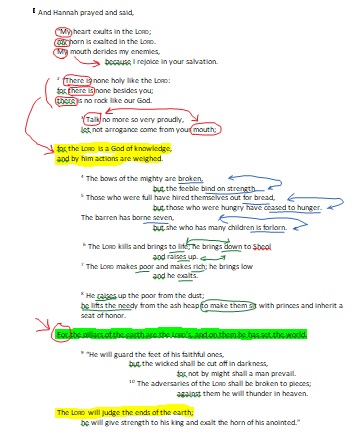
The Pillars of the Earth are the Lord's - 1 Samuel, Part 4


Why did the Holy Spirit inspire Hannah to pray in such a way?  It seems to be left for us as a transition from the birth and dedication of her son, to somewhat a prefiguring of Israel’s history and the ultimate success of a coming king.

As to Israel, Hannah gives praise to “the God who reverses human fortunes by his mighty power, the Creator beyond all human understanding who protects the faithful.”[1]  The bows of the mighty are broken, but the feeble bind on strength. Those who were full have hired themselves out for bread, but those who were hungry have ceased to hunger. The barren has borne seven, but she who has many children is forlorn.” (1 Samuel 2:4–5, ESV).

This is a clear song of praise, glorying (if not wallowing) in the certainty of God over the affairs of human choices and affairs.  I find that the ground for her prayer is seen in the two English words “for” that start to sentences:

1. “For the Lord is a God of knowledge, and by him actions are weighed.” [2]

2.  “For the pillars of the earth are the Lord’s, and on them he has set the world.”[3]

God is neither the subject of human interrogation, nor is he one who answers to mankind.  He is the omniscient One who judges everyone with perfect knowledge.  He is sovereign presiding over all the affairs of mankind. He is behind and before all things. He is the uncaused Cause of all things. “The reference to the foundation or support (“pillars”) of the earth is meaningful here, for the Lord upholds both the place where his people live as well as the moral order of this world; he protects his faithful, while he destroys the wicked (1 Sam. 2:9).”[4]

The Lord controls not only birth and death, but also all events in between.  He reveres the fortunes of the faithful (an obvious reflection by Hannah and the birth of her son) and even brings to pass the unexpected: “The barren has borne seven, but she who has many children is forlorn. “[5]

Hannah concludes mentioning “His anointed”.  This is literally “his messiah”.  This is the first time Messiah appears in the Bible.  She also anticipates the Divinely empowered King that would come, yet at this time in Israel, there was no King.  Fascinating!!  Over time, this same Hebrew term would come to refer to a coming anointed one of God—called the Christ and He the Son of David would rule in righteousness.   The ancient expositors, both Jewish and Christian, make it to look beyond David, to the Son of David. Glorious things are here spoken of the kingdom of the Mediator, both before and since his incarnation; for the method of the administration of it, both by the eternal Word and by that Word made flesh, is much the same.”[6]

This is an amazing prayer in structure and form.  It’s placement in the canon is by design and intent. As 1 Samuel starts with Hannah’s song, the end of 2 Samuel finishes with David’s Song.  This song of Hannah is clearly the foundation form Mary’s Magnificent.  But beyond the beauty of this song of praise, it’s articulation of the uniqueness and the sovereignty of God is unparalleled.

Those who dismiss the sovereignty of God over all things should heed the words of Hannah: “Talk no more so very proudly, let not arrogance come from your mouth.” [7]


[1] Crossway Bibles. (2008). The ESV Study Bible (p. 493). Wheaton, IL: Crossway Bibles.
[2] The Holy Bible: English Standard Version. (2016). (1 Sa 2:3). Wheaton, IL: Crossway Bibles.
[3] The Holy Bible: English Standard Version. (2016). (1 Sa 2:8). Wheaton, IL: Crossway Bibles.
[4] Crossway Bibles. (2008). The ESV Study Bible (p. 494). Wheaton, IL: Crossway Bibles.
[5] The Holy Bible: English Standard Version. (2016). (1 Sa 2:5). Wheaton, IL: Crossway Bibles.
[7] The Holy Bible: English Standard Version. (2016). (1 Sa 2:3). Wheaton, IL: Crossway Bibles.