Search This Blog

Thursday, February 28, 2019

Low Expectations of Teens - 1 Samuel, Part 6


This passage has two bookends:

& “Samuel was ministering before the Lord, a boy clothed with a linen ephod.” (1 Samuel 2:18, ESV)

& “. . . the boy Samuel grew in the presence of the Lord.” (1 Samuel 2:21, ESV)

The linen ephod was likely a garment that identified him as one working in the priesthood.  In verse 11 when he was left by his parents with Samuel, we learn that he served “. . . in the presence of Eli the priest” (1 Samuel 2:11b, ESV).  
Now Samuel was serving “in the presence of the Lord.”[1]

This idea of the “presence of the Lord” is significant to the Bible and to the Christian life.  My cover photo on my Facebook page shows the Latin phrase: Coram Deo, which means “living in the presence of God, under the authority of God, to the glory of God.

We must agree that God is everywhere (Psalm 139:7-8); but at the same time, He chooses to reveal or manifest His presence in localized and intense ways (e.g., Exodus 3:2).  Likewise, the Believer can be assured of God’s continual presence (Hebrews 13:5).  There will be a day when Christians experience God’s unveiled presence (1 John 3:2). 

 “The narrator's description of Samuel's continued growth in the Lord's presence (v.21), as well as in stature and in favor with God and men (v.26), is echoed in Luke's portrayal of Jesus' youth (Luke 2:40, 52).”[2]  It is interesting to me that the author is so clear: “Samuel grew in the presence of the Lord.”  It is speculative but we tend to think of Samuel as a young man, maybe a teen.  Josephus, the Jewish historian though Samuel was about 11 years old. 

Consider the young people you know.  How many, as young teens, could it be said of: they are serving the Lord and growing in His presence?  This is stunning.  Have we expected too little of our young people?  Cameron Cole writes,

“People have very low expectations for teenagers in the Christian context and it’s absurd. We have such high expectations for kids in terms of school—kids are learning foreign languages, taking college-level physics, and holding important leadership roles, like being team captains or leading service projects. And yet in the church, we regard teenagers like they’re toddlers. I think we need to elevate our expectation of what kids can actually do in a church.”[3]

Several years ago I attended a conference where the authors, Alex and Brett Harris spoke on their book: Do the Hard Things.  I later listened to their book on audio.  Alex said, “The teen years are some of the most valuable years of our lives in terms of developing a purposeful mindset and preparing for the future.” “The ‘do hard things’ message is uniquely needed there, because teens are subject to our society’s lowest and most damaging expectations.”  

As the years would pass, Brett’s life became harder. You can read about it HERE.  By God’s grace, by not succumbing to the low expectations as a teen, Brett exceed all expectations as a husband.

Perhaps we need to rethink our expectations of young people.


[1] The Holy Bible: English Standard Version. (2016). (1 Sa 2:21). Wheaton, IL: Crossway Bibles.
[2] Expositor's Bible Commentary, The, Pradis CD-ROM:1 and 2 Samuel/Exposition of First Samuel/I. Prelude to Monarchy in Israel (1:1-7:17)/A. The Childhood of Samuel (1:1-4:1a)/3. The wicked sons of Eli (2:12-26), Book Version: 4.0.2
[3] https://corechristianity.com/resource-library/articles/why-our-expectations-for-teens-in-the-church-are-way-too-low

Monday, February 11, 2019

The Sovereign Call of God - 1 Samuel, Part 5


What was happening in this story?  First, we are told that Eli’s sons took a three-pronged fork and ate whatever meat they brought out of the pot when sacrificing an animal. This was in contradiction with the law for priests, who were commanded to eat the breast and upper thigh of the animals (Leviticus 7:30–34). The priest’s duty was to burn the fat on the altar as a pleasing aroma to the Lord (Leviticus 3: 16). Both fat and blood were barred from human consumption (Leviticus 3: 17), and anyone who offended in this matter was to be “cut off from their people” (Leviticus 7: 25).

The story is bookended with two statements:

“Now the sons of Eli were worthless men. They did not know the Lord.” (1 Samuel 2:12, ESV)

And

“Thus the sin of the young men was very great in the sight of the Lord, for the men treated the offering of the Lord with contempt.” (1 Samuel 2:17, ESV)

“The Hebrew text here calls Eli’s sons benei beliyya’al, which is literally rendered as “sons of Belial.”[1] The cause of such a horrid characterization is that “they did not know the LORD.” The result was a egregious sin before God because in the end they were treating the offering of the LORD with contempt.

Why is this story included in the canon?  Will there are a couple of reasons that will surface, but the immediate one is that these men are seen in contrast to Samuel. The NIV and NASB text in verse 18 start with “But Samuel”.  Unlike these men (Hophni and Phinehas) who were stealing and being gluttonous with God’s offering and showing contempt for His offering, Samuel was serving before the Lord.

The inspired author draws the distinction based upon this one fact: “they did not know the LORD”.  Now as priests they would have known His commands and precepts.  They knew they were in contravention with God’s Word, there problem was that they did not know God.  The boy Samuel (to read on) did not know the Lord yet (“Now Samuel did not yet know the Lord, and the word of the Lord had not yet been revealed to him.” (1 Samuel 3:7, ESV) but he would when the Lord revealed Himself to him.

This is the key. In Matthew 11:25–26 (ESV), we read:

25 At that time Jesus declared, “I thank you, Father, Lord of heaven and earth, that you have hidden these things from the wise and understanding and revealed them to little children; 26 yes, Father, for such was your gracious will.

 It ultimately requires the sovereign will of God to reveal Himself to people.  Those who know Him, follow Him.  Someone might counter, “Well how can God judge someone to whom the Father has not chosen to reveal Himself to?”  Paul would answer:

“You will say to me then, “Why does he still find fault? For who can resist his will?” But who are you, O man, to answer back to God? Will what is molded say to its molder, “Why have you made me like this?” Has the potter no right over the clay, to make out of the same lump one vessel for honorable use and another for dishonorable use? What if God, desiring to show his wrath and to make known his power, has endured with much patience vessels of wrath prepared for destruction, in order to make known the riches of his glory for vessels of mercy, which he has prepared beforehand for glory— even us whom he has called, not from the Jews only but also from the Gentiles?” (Romans 9:19–24, ESV)

Thus little Samuel, while he was sleeping was the gracious subject of the Lord’s mercy: “The lamp of God had not yet gone out, and Samuel was lying down in the temple of the Lord, where the ark of God was. Then the Lord called Samuel, and he said, “Here I am!”” (1 Samuel 3:3–4, ESV)

We who are “the called” are totally and completely thankful, for without the sovereign, initiatory call we would not know God, nor serve Him as we ought.  We would stand condemned, worthless, having been judged as people who showed contempt for the Lord’s offering.


[1] Barry, J. D., Mangum, D., Brown, D. R., Heiser, M. S., Custis, M., Ritzema, E., … Bomar, D. (2012, 2016). Faithlife Study Bible (1 Sa 2:12). Bellingham, WA: Lexham Press.

Friday, February 1, 2019

The Pillars of the Earth are the Lord's - 1 Samuel, Part 4


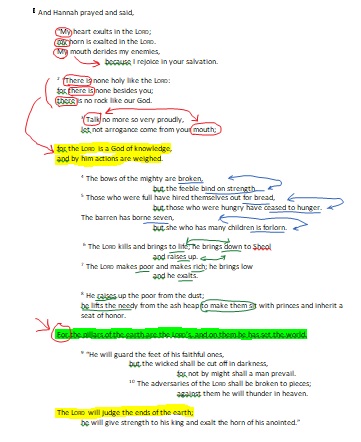
Why did the Holy Spirit inspire Hannah to pray in such a way?  It seems to be left for us as a transition from the birth and dedication of her son, to somewhat a prefiguring of Israel’s history and the ultimate success of a coming king.

As to Israel, Hannah gives praise to “the God who reverses human fortunes by his mighty power, the Creator beyond all human understanding who protects the faithful.”[1]  “The bows of the mighty are broken, but the feeble bind on strength. Those who were full have hired themselves out for bread, but those who were hungry have ceased to hunger. The barren has borne seven, but she who has many children is forlorn.” (1 Samuel 2:4–5, ESV).

This is a clear song of praise, glorying (if not wallowing) in the certainty of God over the affairs of human choices and affairs.  I find that the ground for her prayer is seen in the two English words “for” that start to sentences:

1. “For the Lord is a God of knowledge, and by him actions are weighed.” [2]

2.  “For the pillars of the earth are the Lord’s, and on them he has set the world.”[3]

God is neither the subject of human interrogation, nor is he one who answers to mankind.  He is the omniscient One who judges everyone with perfect knowledge.  He is sovereign presiding over all the affairs of mankind. He is behind and before all things. He is the uncaused Cause of all things. “The reference to the foundation or support (“pillars”) of the earth is meaningful here, for the Lord upholds both the place where his people live as well as the moral order of this world; he protects his faithful, while he destroys the wicked (1 Sam. 2:9).”[4]

The Lord controls not only birth and death, but also all events in between.  He reveres the fortunes of the faithful (an obvious reflection by Hannah and the birth of her son) and even brings to pass the unexpected: “The barren has borne seven, but she who has many children is forlorn. “[5]

Hannah concludes mentioning “His anointed”.  This is literally “his messiah”.  This is the first time Messiah appears in the Bible.  She also anticipates the Divinely empowered King that would come, yet at this time in Israel, there was no King.  Fascinating!!  Over time, this same Hebrew term would come to refer to a coming anointed one of God—called the Christ and He the Son of David would rule in righteousness.   “The ancient expositors, both Jewish and Christian, make it to look beyond David, to the Son of David. Glorious things are here spoken of the kingdom of the Mediator, both before and since his incarnation; for the method of the administration of it, both by the eternal Word and by that Word made flesh, is much the same.”[6]

This is an amazing prayer in structure and form.  It’s placement in the canon is by design and intent. As 1 Samuel starts with Hannah’s song, the end of 2 Samuel finishes with David’s Song.  This song of Hannah is clearly the foundation form Mary’s Magnificent.  But beyond the beauty of this song of praise, it’s articulation of the uniqueness and the sovereignty of God is unparalleled.

Those who dismiss the sovereignty of God over all things should heed the words of Hannah: “Talk no more so very proudly, let not arrogance come from your mouth.” [7]


[1] Crossway Bibles. (2008). The ESV Study Bible (p. 493). Wheaton, IL: Crossway Bibles.
[2] The Holy Bible: English Standard Version. (2016). (1 Sa 2:3). Wheaton, IL: Crossway Bibles.
[3] The Holy Bible: English Standard Version. (2016). (1 Sa 2:8). Wheaton, IL: Crossway Bibles.
[4] Crossway Bibles. (2008). The ESV Study Bible (p. 494). Wheaton, IL: Crossway Bibles.
[5] The Holy Bible: English Standard Version. (2016). (1 Sa 2:5). Wheaton, IL: Crossway Bibles.
[7] The Holy Bible: English Standard Version. (2016). (1 Sa 2:3). Wheaton, IL: Crossway Bibles.

Tuesday, January 29, 2019

Are We Thankful For Our Children? - 1 Samuel, Part 3


There is the appearance of a loving and supportive marriage between Elkanah and Hannah.  The account already reflects his affection for her.  In this passage we see that he also entered into the vow she made before the Lord. The vow is now revealed before us: Samuel was to be “lent” to the LORD as long as he lives, “so that he may appear in the presence of the Lord and dwell there forever.”[1]  Wisely Hannah would wait to fulfill this vow after Samuel is weaned.

So about two to three years later she went to the Temple to fulfill the vow. Along with the boy, she took an offering. “According to Numbers 15:8–10, a bull, flour, and wine were to be sacrificed in fulfillment of a vow. Hannah brought all 3 in larger measure than required.”[2] “Elkanah apparently was a prosperous man who was able to afford an expensive offering of a bull or bulls and large amounts of grain and wine.”[3]  These stipulations in Numbers 15 recognized the thanksgiving offered to God for His bountiful provision when Israel entered the land.  The land was symbolic of abundance and prosperity including a promised posterity.

Hannah fulfilled her promise.  Young Samuel was left with the priest, Eli.  She “lent” her son to the Lord – forever! The Hebrew word that the ESV translates “lent” is probably a poor choice. “The Hiphil of שָׁאַל (shaʾal) might mean “to loan,” or “to treat as requested”.”[4] I think the NIV is a better rendering: “So now I give him to the Lord. For his whole life he will be given over to the Lord.” And he worshiped the Lord there.” (1 Samuel 1:28, NIV).  “The son Hannah requested God had given, and she gives her gift back to the Giver.”[5]

“And he worshiped the Lord there.”[6]  Who is the “he”?  The EBC thinks it to be Eli. “Eli responded to Hannah's brief remarks by worshiping the God whom they both served (v.28).”[7]  Some might think it to be Elkanah; but it very well may have been Samuel.  If so, this reflects Samuel’s ready and willing cooperation with the will of his parents. 

The fulfillment of Hannah’s vow and the dedication of her son to the Lord, for his lifetime, was accompanied by a generous thank offering.  Later Paul was to say, “I appeal to you therefore, brothers, by the mercies of God, to present your bodies as a living sacrifice, holy and acceptable to God, which is your spiritual worship.” (Romans 12:1, ESV).  In Numbers 15 Israel was also called to continually offer thanks to God for the provision of his abundance.  In a very practical way, those of us who have received the gift of children, what better response would it be to dedicate them to the Lord in thanks for his gift to us? 

Interestingly the book of Proverbs calls us who are parents to a similar response.  Proverbs 22:6 (ESV) commands, “6 Train up a child in the way he should go; even when he is old he will not depart from it.” The Hebrew verb translated “train” occurs three other times in the Bible. In each of these, it refers to “dedicating” houses, either a person’s house of God’s house.  “To train up a child in the way he should go means to dedicate him or her toward the right goal, or stated otherwise: “train him or her as God would”.  This calls for parents to actively devote or commit their youth to a certain way – a certain path. 

When we as parents daily dedicate our children to the Lord, we affirm that we don’t own them, God does. Therefore, we need to seek the assistance to raise them to know the Lord.  Therefore, we rest on God’s Word, His Holy Spirit and the influence of God’s people.  We must raise them as if God was raising them.

As parents of a dedicated child, they don’t have the right to just pass down their personal opinions and the wisdom and values of this world. We must pass to them the values of God’s Word, the Gospel and holy living that relies on the power of Christ.  

The consequence of Proverbs 22:6 implies that the parents’ intentional Christ-centered, Gospel-centered shaping in the early years may have a permanent effect on their child for good. This statement is not a hard-and-fast promise to parents, however, for the rest of the book makes clear that the power of the youth’s future depends not only on the parents’ guidance but also very much on the choices he or she makes.

Parents don’t have to take their children to a church building and leave them there.  No, they can daily bring their children to Christ and nurture them as Christ would in the truth of God’s Word through the glorious Gospel.   This is how we express our gratitude.


[1] The Holy Bible: English Standard Version. (2016). (1 Sa 1:22). Wheaton, IL: Crossway Bibles.
[2] MacArthur, J., Jr. (Ed.). (1997). The MacArthur Study Bible (electronic ed., p. 378). Nashville, TN: Word Pub.
[3] Crossway Bibles. (2008). The ESV Study Bible (p. 492). Wheaton, IL: Crossway Bibles.
[5] MacArthur, J., Jr. (Ed.). (1997). The MacArthur Study Bible (electronic ed., p. 378). Nashville, TN: Word Pub.
[6] The Holy Bible: English Standard Version. (2016). (1 Sa 1:28). Wheaton, IL: Crossway Bibles.
[7] Expositor's Bible Commentary, The, Pradis CD-ROM:1 and 2 Samuel/Exposition of First Samuel/I. Prelude to Monarchy in Israel (1:1-7:17)/A. The Childhood of Samuel (1:1-4:1a)/1. The birth and dedication of Samuel (1:1-28), Book Version: 4.0.2


Thursday, January 24, 2019

Transforming Your Countenance - 1 Samuel Part 2


The distraught and discouraged Hannah, grieving her barrenness; seemingly ignoring her husband’s reminder of his love, gets up and leaves the fellowship/peace meal.  Hannah stands out in the Old Testament.  No other woman specifically is recorded in the Old Testament going to the House of God and no other woman is recorded to have made and kept a vow to God.[1]

Hannah pledged to give her son to God in exchange for God’s gift of that son.  She calls upon God, the LORD of Hosts. The capitalized LORD in our Bible indicates that the author is referring to Jehovah, the eternal, self-existent God who saves.  “Hosts” is the Hebrew word Sabaoth (Those familiar with Martin Luther’s hymn, A Mighty Fortress, will recognize this.) meaning “God of the armies of heaven” or simply translated LORD Almighty.  Only Jehovah Sabaoth can give this troubled woman a child. 

She prayed, “remember me and not forget your servant, but will give to your servant a son, then I will give him to the Lord all the days of his life, and no razor shall touch his head.”[2]  Although not specified this is undoubtedly a reference to the Nazarite vow (Numbers 6:4f).  This vow, often taken for a specific period of time is offered by Hannah for a lifetime commitment.  Samson is specifically called a Nazirite (Judges 13:7) and it is possible that Paul may have participated in something like the Nazirite vow (Acts 21:23–27).[3]

Eli, the priest mistakenly took Hannah to be drunk as she lips were moving, but she was praying in her heart. She responded to his rebuke with humility and Eli answered her, “Go in peace, and the God of Israel grant your petition that you have made to him.”” (1 Samuel 1:17, ESV).  The narrative concludes with the recorded answer to that promise: “And in due time Hannah conceived and bore a son, and she called his name Samuel, for she said, “I have asked for him from the Lord.”” (1 Samuel 1:20, ESV)

There are several cautionary notes that must be considered.  Although God showed grace to Hannah and answered her prayer, this in no means permits us to bargain with God.  And certainly, women today cannot claim by faith that God will give them a child because of their piety. All this was done in Hannah and God is to be glorified.  One of the contemporary lessons for us is found in verse 18: “Then the woman went her way and ate, and her face was no longer sad.”[4]  Why the sudden change from “distraught” to “cheerful”?  

Matthew Henry correctly affirms: “She had by prayer committed her case to God and left it with him, and now she was no more perplexed about it.”[5] Someone has said that prayer changes things.  In this case prayer changed the petitioner. As Paul would later write: “do not be anxious about anything, but in everything by prayer and supplication with thanksgiving let your requests be made known to God. And the peace of God, which surpasses all understanding, will guard your hearts and your minds in Christ Jesus.” (Philippians 4:6–7, ESV).   The loved hymn of Joseph Scriven[6] comes to mind, particularly the first stanza:

Verse 1
What a friend we have in Jesus
All our sins and griefs to bear
What a privilege to carry
Everything to God in prayer
O what peace we often forfeit
O what needless pain we bear
All because we do not carry
Everything to God in prayer [emphasis mine]

There is nothing like humble, believing prayer to transform the countenance.  True and confident faith can only come from the promises of God.  For every need there is a promise.  For the “Hannahs” of this world there is a promise: “For the Lord God is a sun and shield; the Lord bestows favor and honor. No good thing does he withhold from those who walk uprightly. O Lord of hosts, blessed is the one who trusts in you!” (Psalm 84:11–12, ESV)

For all Christians, anywhere and anytime, we can affirm: “And we know that for those who love God all things work together for good, for those who are called according to his purpose.” (Romans 8:28, ESV)

And “You keep him in perfect peace whose mind is stayed on you, because he trusts in you.” (Isaiah 26:3, ESV)


_________________________________

The first of this series is found HERE!


[1] Barry, J. D., Mangum, D., Brown, D. R., Heiser, M. S., Custis, M., Ritzema, E., … Bomar, D. (2012, 2016). Faithlife Study Bible (1 Sa 1:9). Bellingham, WA: Lexham Press.
[2] The Holy Bible: English Standard Version. (2016). (1 Sa 1:11). Wheaton, IL: Crossway Bibles.
[3] Franklin, J. C. (2016). Nazirite. In J. D. Barry, D. Bomar, D. R. Brown, R. Klippenstein, D. Mangum, C. Sinclair Wolcott, … W. Widder (Eds.), The Lexham Bible Dictionary. Bellingham, WA: Lexham Press.
[4] The Holy Bible: English Standard Version. (2016). (1 Sa 1:18). Wheaton, IL: Crossway Bibles.
[6] What A Friend We Have In Jesus, Charles Crozat Converse | Joseph Medlicott Scriven, © Words: Public Domain

Tuesday, January 22, 2019

The Lord Saves Not With Sword and Spear - 1 Samuel, Part 1


The key verse in 1 Samuel is found in Chapter 2:7-8:

“The Lord makes poor and makes rich; he brings low and he exalts. He raises up the poor from the dust; he lifts the needy from the ash heap to make them sit with princes and inherit a seat of honor. For the pillars of the earth are the Lord’s, and on them he has set the world.”[1]

1 Samuel is a book of transition between the times of the Judges and the beginning of Israel’s monarchy.  The prophet Samuel is a link between these two economies.  Like the Book of Ruth, the author opens with a real life story in an Israelite home.  Like Ruth, the story is a microcosm of the bigger story of Israel. It’s a story of universal implications: God exalts the weak and humbles the proud. 

The story opens with a man named Elkanah who probably married the love of his life: Hannah.  She couldn’t have children.  Twice we learn that it is God who has prohibited her from having children. In order to raise up a seed Elkanah marries another women who gives birth to several sons and daughters. On the surface it is obvious which women is the honored one and which is not – which is the weak and which is the lofty.

The story also portrays the journey of a husband and wife toward significance and a sense of accomplishment and worth.  The husband’s sincere love for this woman and his lavish treatment of her causes him to expect that she considers him “more to you than ten sons?”[2]  Ten sons! The perfect family! But unknown to Elkanah, he cannot satisfy the longing of her heart, alone.  She too is torn by abusive and provoking actions by the “other woman”.  She too is torn by the cultural, and yes, the religious passion to “go forth and multiply.” 

Hannah’s name means “Grace”.  It is surely grace that she needs more than her husband’s honest and heartfelt affection.  It is surely grace that she needs more than acceptance in her peer community.  It is certainly grace that she needs, more than becoming a mother. 

Israel needs grace.  It will become apparent that they will seek it by means other than God’s ideal.  As Peter would later write:

“God opposes the proud but gives grace to the humble. Humble yourselves, therefore, under the mighty hand of God so that at the proper time he may exalt you.”[3]


[1] The Holy Bible: English Standard Version. (2016). (1 Sa 2:7–8). Wheaton, IL: Crossway Bibles.
[2] The Holy Bible: English Standard Version. (2016). (1 Sa 1:8). Wheaton, IL: Crossway Bibles.
[3] The Holy Bible: English Standard Version. (2016). (1 Pe 5:5–6). Wheaton, IL: Crossway Bibles.

Monday, January 7, 2019

He Is Able


The recurring New Testament phrase, “He is able”, is a fear-crushing, faith-building phrase.  It is one word in the original language”: δύναμαι, pronounced, ‘doo·nam·ahee’.  Strong defines it in such ways as: “to have power whether by virtue of one’s own ability and resources, or to be capable, strong and powerful.”[1]  Note the “ability” of God and be encouraged:

Romans 4:20–21 (ESV)
20 No unbelief made him waver concerning the promise of God, but he grew strong in his faith as he gave glory to God, 21 fully convinced that God was able to do what he had promised.

Romans 14:4 (ESV)
4 Who are you to pass judgment on the servant of another? It is before his own master that he stands or falls. And he will be upheld, for the Lord is able to make him stand.

Romans 16:25 (ESV)
25 Now to him who is able to strengthen you according to my gospel and the preaching of Jesus Christ, according to the revelation of the mystery that was kept secret for long ages.

2 Corinthians 9:8 (ESV)
8 And God is able to make all grace abound to you, so that having all sufficiency in all things at all times, you may abound in every good work.

Ephesians 3:20 (ESV)
20 Now to him who is able to do far more abundantly than all that we ask or think, according to the power at work within us.

2 Timothy 1:12 (ESV)
12 which is why I suffer as I do. But I am not ashamed, for I know whom I have believed, and I am convinced that he is able to guard until that day what has been entrusted to me.

Hebrews 2:18 (ESV)
18 For because he himself has suffered when tempted, he is able to help those who are being tempted.

Hebrews 7:25 (ESV)
25 Consequently, he is able to save to the uttermost those who draw near to God through him, since he always lives to make intercession for them.

Jude 24 (ESV)
24 Now to him who is able to keep you from stumbling and to present you blameless before the presence of his glory with great joy.


[1] Strong, J. (1995). Enhanced Strong’s Lexicon. Woodside Bible Fellowship.