Search This Blog

Showing posts with label interpretation. Show all posts

Thursday, November 14, 2024

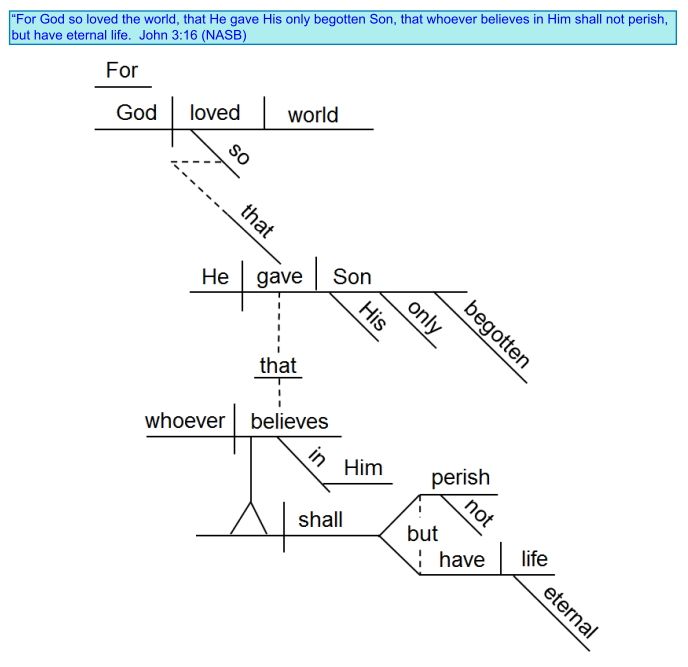
Sentence Diagramming — a Picture of the Text that’s worth a thousand words!

I do not claim to be perfect in any way, nor am I skilled in original languages. But for many years I practiced, albeit imperfectly the discipline of sentence diagramming. By this I sought to carefully considering the relationships between clauses, phrases, and other parts of speech realizing that it is vital to understanding the biblical text. 

Here is an example. I am confident that I have gleaned the main idea and the argument of the text.  I am also confident that without sentence diagramming, I would have ended up at a different point.  I’ve summarized the results in a sermon plan.


“To win the favor of the world and its despots 

means to lose the favor of heaven.

To win the favor of heaven 

means to lose the favor of the world.” - Garland


Illustration: “Why Jesus requires assistance from Simon is not stated by Luke, who seems more interested in providing a reminder of the implications of Jesus’ faithfulness to God’s purpose for those who want to follow him in discipleship:

9: 23: If any want to become my followers, let them … take up their cross daily and follow me.

14: 27: Whoever does not carry the cross and follow me cannot be my disciple. 23: 26: They laid the cross on him, and made him carry it behind Jesus.”

                        — Joel B. Green


Theme: The Mission of Christ


Main Point: Anyone that wishes to follow Christ must join Him on Mission


The Cost of Following Christ on Mission: To join the ranks of those condemned by the world; a world that is adulterous and sinful.


The following quote was added after I first published this blog:


“The place of suffering in service and of passion in mission is hardly ever taught today. But the greatest single secret of evangelistic or missionary effectiveness is the willingness to suffer and die. It may be a death to popularity (by faithfully preaching the unpopular biblical gospel), or to pride (by the use of modest methods in reliance on the Holy Spirit), or to racial and national prejudice (by identification with another culture), or to material comfort (by adopting a simple lifestyle). But the servant must suffer if he is to bring light to the nations, and the seed must die if it is to multiply.”  - John Stott


http://www.justworshipgod.com/2015/08/12-classic-quotes-from-john-stott-cross.html?m=1


Comments or Helpful Critiques are always welcome


Wednesday, December 29, 2021

The End of the Bible Reading Program for 2021

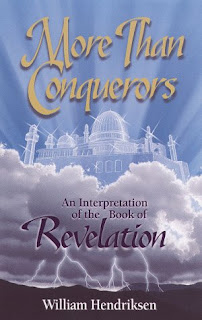
For many of us who follow a read-through-the-Bible-in-a-year program, we have entered into the Revelation of Jesus Christ — the last of the New Testament canon.  William Hendrikson [1] reminds us that the Revelation is neither an entirely futuristic Book or a chronological Book:

“Every paragraph of this glorious prophecy is filled with significance, instruction and comfort for the seven churches of proconsular Asia. This book is an answer to the crying need of that particular day, and we must permit contemporaneous circumstances to shed their light on its symbols and predictions. True, this book has a message for today, but we shall never be able to understand ‘what the Spirit is saying to the churches’ of today unless we first of all study the specific needs and circumstances of the seven churches of ‘Asia’ as they existed in the first century AD.”

“A careful reading of the book of Revelation has made it clear that the book consists of seven sections, and that these seven sections run parallel to one another. Each of them spans the entire dispensation from the first to the second coming of Christ.”

“ Each section gives us a description of the entire gospel age, from the first to the second coming of Christ, and is rooted in Israel’s history under the old dispensation to which there are frequent references.”

“ Our division is as follows: 1. Christ in the midst of the seven golden lampstands (1–3). 2. The book with seven seals (4–7). 3. The seven trumpets of judgment (8–11). 4. The woman and the Man-child persecuted by the dragon and his helpers (the beast and the harlot) (12–14). 5. The seven bowls of wrath (15, 16). 5. The seven bowls of wrath (15, 16). 6. The fall of the great harlot and of the beasts (17–19). 7. The judgment upon the dragon (Satan) followed by the new heaven and earth, new Jerusalem (20–22).”

“ The Apocalypse is steeped in the thoughts and images of the Old Testament . . . Westcott and Hort give nearly four hundred references or allusions to the Old Testament, and an intensive study of any chapter of the Apocalypse soon reveals that this list of four hundred references is itself incomplete. It is on the basis of these sacred Scriptures [Old Testament] that we must interpret the Apocalypse.“


__________________________________________

1. Henrikson, William, More Than Conquerors, An Interpretation of the Book of Revelation, Baker Publishing Group, Grand Rapids, Michigan, © 1940, 1967 


Tuesday, December 30, 2014

Just BECAUSE ..... Part 3

Another way of describing the thought process that I've been writing about in the last two blogs (HERE and HERE), is to think of this in terms of means to an end.  God, as the Uncaused Cause of the Universe, sovereign in every way, determines both the ends and the means.  God is the primary cause of all events by virtue of His fore-ordination of all events.   But God normally uses means or secondary causes.  We can fail on this score in several ways:

  1. By dismissing one cause, or devaluing one cause for the sake of the other.
  2. By considering secondary causes of greater influence than the Primary Cause.
  3. By making secondary causes irrelevant because of the greater cause.
It is pagan at worst or sub-Christian at best to ever think that a secondary cause can move the Primary Cause.  I read such a quote yesterday.  A person wrote, "God elects the whole world to salvation but mankind can refuse or frustrate that choice."  That is pure idolatry.  At the same time God has chosen to use means such as the preaching of the Gospel, repentance and faith to save His elect.  These means are not negotiable.  

Understanding multiple causes in God's interaction with humans while maintaining His sovereign primacy is of great help us in understanding Scripture and giving due glory to the right cause.  For example consider this verse in Romans 9:18 (NIV),

18 Therefore God has mercy on whom he wants to have mercy, and he hardens whom he wants to harden.

The Bible reader is immediately taken back to the story of the Exodus where God promised Moses But I will harden Pharaoh’s heart, and though I multiply my signs and wonders in Egypt,” (Exodus 7:3, NIV).  Sincere Christians will wonder about such a statement.  But when one considers that God is acting as the primary cause, but using secondary causes it brings perspective.  Initially “Pharaoh said, “Who is the Lord, that I should obey him and let Israel go? I do not know the Lord and I will not let Israel go.”” (Exodus 5:2, NIV).  And it is obvious that God had decreed that the longer this king resists His will, the harder his heart would become, to the point that it was cemented into permanent indifference to God.  

A danger in reading your Bible is to embrace one evidence of causation and run with it, to the exclusion of all other evidences.  This impacts almost every dimension of Christianity that I can think of, from prayer to perseverance; from evangelism to edification.  I have learned to ask two questions when I study:
  1. Is this a Primary or Secondary cause; and
  2. Whatever it is, where is its corollary?
So in the case of Pharaoh I ask, "Is this a statement of Primary Causation?"  Yes!  Question 2: "What means did God use?"  Answer:  Pharaoh's stubborn, idolatrous will.  The New Living Bible captures the sense of this well: “Human defiance only enhances your glory, for you use it as a weapon.” (Psalm 76:10, NLT)
 
"God raises up men like Pharaoh and Pilate to accomplish his ends. Yet, their actions are free and morally accountable. Their sin does not thwart the eternal decree of God, but rather is encompassed in his divine plan so that he is without sin (Ps. 17.14). He is the potter and we are the clay (Rom. 9) . . . In this way, in accordance with the eternal decree of God, who alone is the first cause, all that comes to pass -- the unfolding of history, as it were -- is encompassed in the sovereign providential government of God, over all creation, rational agents and otherwise, which thereby, as the Confession says, establishes the nature of second causes." [1]

To God be the glory.

______________________________________________
1. http://www.puritanboard.com/f48/secondary-causes-15115/


Monday, February 11, 2013

Faith of Our "Apostolic Fathers"

I recently joined a 'reading group' who have decided to read the Apostolic Fathers.  As I follow the schedule I hope to collect my thoughts in this blog.  Our gracious facilitator reminded us a couple things about these men and the era they lived in.  First of all it should be noted that they did "theology in community, not in isolation."   That is a fascinating point.   If I have grasped this right that means from the inception, to the development and even the analysis of Christian theology, it didn't occur in the sequestered life of a monastery, nor in the isolation of a seminary. Theology was understood, worked out and lived out in community. As a side-bar, I have learned of the most obscure ideas that originate in the mind of individuals who hold to private interpretation and fail to work it out in community.  
 
The second notable point was that this theology reflected a developmental journey.  For us today who have the advantage of Councils, Systematic Theologies and the like, it proves to be somewhat foreign to recognize that there was a time when our theological under-pinnings were in process. 
 
We learned that the men we now call "Apostolic Fathers" were not know this until the 17th Century.  It seems that the term is used primarily because of their relationship or proximity to the Twelve Apostles of Christ.  All the Twelve had died by 100 A.D. but at least one of the group we call "Apostolic Fathers" worked with or knew the Apostles John and Paul.  These "Fathers" were Greek speaking (therefore their work is a translation) and they all lived prior to the great Church councils.
 
Why would they be called "Fathers"?  We sing a hymn from time to time, written by Frederick W. Faber:
 
Faith of our fathers, living still,
In spite of dungeon, fire and sword;
O how our hearts beat high with joy
Whenever we hear that glorious Word!


Refrain
Faith of our fathers, holy faith!
We will be true to thee till death.
 
It would seem that to designate these men as "Fathers" is to anticipate their influence in our lives as spiritual parents.  This is not unlike Paul's relationship to Timothy (1 Timothy 1:2) and Titus.  For example: “To Titus, my true child in a common faith: Grace and peace from God the Father and Christ Jesus our Savior.” (Titus 1:4, ESV).  We then might think of these men as parenting us spiritually.  But what of Christ's admonition found in Matthew 23:9 (ESV), "9 And call no man your father on earth, for you have one Father, who is in heaven?"   The notation in the Reformation Study Bible is helpful here.  There we read:
 
"Jesus does not prohibit organization or the use of all titles in the church (cf. Acts 20:17; 1 Cor. 9:1; 1 Tim. 3:1, 2, 8, 12; Titus 1:5–7). His warning is against the temptation to accord human leaders the authority and prerogatives that belong to God alone—a temptation here exemplified by the use of pretentious forms of address."

The application is clear. These "Fathers" are men.  Their instruction and authority does not exceed our Lord.  They are not infallible.  Their work requires examination and testing.  As Paul wrote to the Thessalonians: “but test everything; hold fast what is good.” (1 Thessalonians 5:21, ESV).  These presumes there is some elements that may be imperfect.  There is also some good that should be embraced. Our facilitator reminded us "Remember that at least some of these documents are penned by men who laid down their lives for the Lord and for their brothers and sisters.  They deserve our respect even if we don't always agree with them."