Search This Blog

Showing posts with label Hermeneutics. Show all posts

Thursday, November 14, 2024

Sentence Diagramming — a Picture of the Text that’s worth a thousand words!

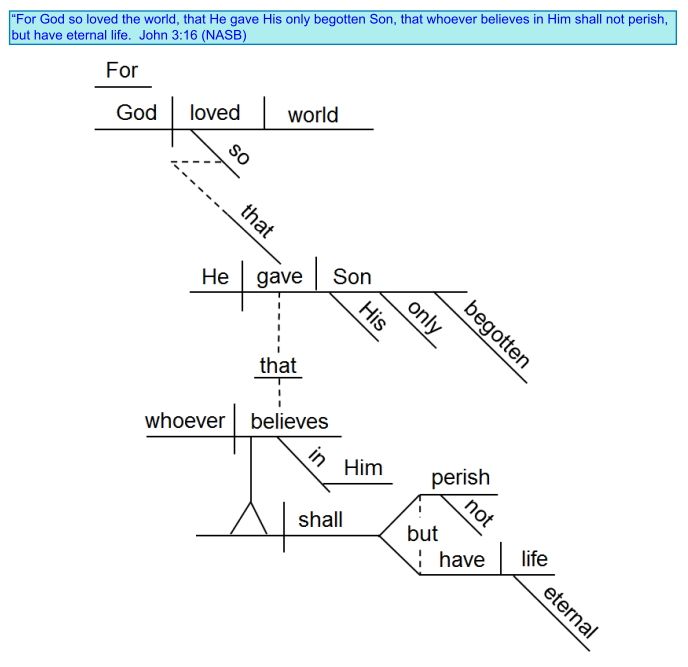
I do not claim to be perfect in any way, nor am I skilled in original languages. But for many years I practiced, albeit imperfectly the discipline of sentence diagramming. By this I sought to carefully considering the relationships between clauses, phrases, and other parts of speech realizing that it is vital to understanding the biblical text. 

Here is an example. I am confident that I have gleaned the main idea and the argument of the text.  I am also confident that without sentence diagramming, I would have ended up at a different point.  I’ve summarized the results in a sermon plan.


“To win the favor of the world and its despots 

means to lose the favor of heaven.

To win the favor of heaven 

means to lose the favor of the world.” - Garland


Illustration: “Why Jesus requires assistance from Simon is not stated by Luke, who seems more interested in providing a reminder of the implications of Jesus’ faithfulness to God’s purpose for those who want to follow him in discipleship:

9: 23: If any want to become my followers, let them … take up their cross daily and follow me.

14: 27: Whoever does not carry the cross and follow me cannot be my disciple. 23: 26: They laid the cross on him, and made him carry it behind Jesus.”

                        — Joel B. Green


Theme: The Mission of Christ


Main Point: Anyone that wishes to follow Christ must join Him on Mission


The Cost of Following Christ on Mission: To join the ranks of those condemned by the world; a world that is adulterous and sinful.


The following quote was added after I first published this blog:


“The place of suffering in service and of passion in mission is hardly ever taught today. But the greatest single secret of evangelistic or missionary effectiveness is the willingness to suffer and die. It may be a death to popularity (by faithfully preaching the unpopular biblical gospel), or to pride (by the use of modest methods in reliance on the Holy Spirit), or to racial and national prejudice (by identification with another culture), or to material comfort (by adopting a simple lifestyle). But the servant must suffer if he is to bring light to the nations, and the seed must die if it is to multiply.”  - John Stott


http://www.justworshipgod.com/2015/08/12-classic-quotes-from-john-stott-cross.html?m=1


Comments or Helpful Critiques are always welcome


Wednesday, December 29, 2021

The End of the Bible Reading Program for 2021

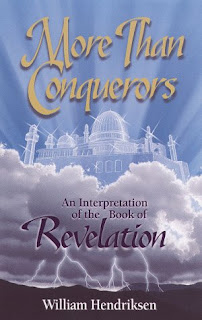
For many of us who follow a read-through-the-Bible-in-a-year program, we have entered into the Revelation of Jesus Christ — the last of the New Testament canon.  William Hendrikson [1] reminds us that the Revelation is neither an entirely futuristic Book or a chronological Book:

“Every paragraph of this glorious prophecy is filled with significance, instruction and comfort for the seven churches of proconsular Asia. This book is an answer to the crying need of that particular day, and we must permit contemporaneous circumstances to shed their light on its symbols and predictions. True, this book has a message for today, but we shall never be able to understand ‘what the Spirit is saying to the churches’ of today unless we first of all study the specific needs and circumstances of the seven churches of ‘Asia’ as they existed in the first century AD.”

“A careful reading of the book of Revelation has made it clear that the book consists of seven sections, and that these seven sections run parallel to one another. Each of them spans the entire dispensation from the first to the second coming of Christ.”

“ Each section gives us a description of the entire gospel age, from the first to the second coming of Christ, and is rooted in Israel’s history under the old dispensation to which there are frequent references.”

“ Our division is as follows: 1. Christ in the midst of the seven golden lampstands (1–3). 2. The book with seven seals (4–7). 3. The seven trumpets of judgment (8–11). 4. The woman and the Man-child persecuted by the dragon and his helpers (the beast and the harlot) (12–14). 5. The seven bowls of wrath (15, 16). 5. The seven bowls of wrath (15, 16). 6. The fall of the great harlot and of the beasts (17–19). 7. The judgment upon the dragon (Satan) followed by the new heaven and earth, new Jerusalem (20–22).”

“ The Apocalypse is steeped in the thoughts and images of the Old Testament . . . Westcott and Hort give nearly four hundred references or allusions to the Old Testament, and an intensive study of any chapter of the Apocalypse soon reveals that this list of four hundred references is itself incomplete. It is on the basis of these sacred Scriptures [Old Testament] that we must interpret the Apocalypse.“


__________________________________________

1. Henrikson, William, More Than Conquerors, An Interpretation of the Book of Revelation, Baker Publishing Group, Grand Rapids, Michigan, © 1940, 1967 


Monday, July 21, 2014

The Promise Keeper

Galatians 3:15–17 (NIV),

15 Brothers and sisters, let me take an example from everyday life. Just as no one can set aside or add to a human covenant that has been duly established, so it is in this case. 16 The promises were spoken to Abraham and to his seed. Scripture does not say “and to seeds,” meaning many people, but “and to your seed,” meaning one person, who is Christ. 17 What I mean is this: The law, introduced 430 years later, does not set aside the covenant previously established by God and thus do away with the promise.

"Paul takes an analogy from human affairs of everyday life and illustrates his point so clearly that all can understand." [1]  If it is the general ethic of human nature to honor a promise made, why would it not be so with God when He made a promise to Abraham.  "As if he should say, the testaments of men and such other corruptible things are strictly executed, and that which the law commandeth is diligently observed and kept." [2]  So Paul moves from this analogy to state the point: “The promises were spoken to Abraham and to his seed . . ..” (Galatians 3:16, NIV).

"Now, the promises are made to Abraham, not in all his descendants in many seeds, but in one seed which is Christ." [2] "Paul knows that the singular (Hb. zera‘) can be used as a collective singular that has a plural sense (he interprets it in a plural sense in Rom. 4:18)." [3]  "Paul asserts that God’s promises are not restricted to the biological descendants of Abraham. The promise of blessing, Spirit, and faith refer to Christ, who is representative of all people—not just Jewish people. This narrow application of the promise to Christ allows for a broad application of the promise to all people, including Gentiles." [4]  This is an important hermeneutical principle that enables us to understand the Old Testament promises.  All the promises of God are fulfilled in the collective, singularity of Christ.

"Here the Jews might object, that God was not only content to give promises to Abraham, but also after four hundred and thirty years He made the law . . . The law, saith he, was given four hundred and thirty years after this promise was made: and it could not make the promise void and unprofitable: for the promise is the testament of God, confirmed by God Himself in Christ, so many years before the law. Now, that which God once hath promised and confirmed He calleth not back again, but it remaineth rati- fied and sure for ever." [5]

So Paul argues from the basis of time that the Law cannot supersede a promise already made.  He also argues from the basis of essence.  The Law is different than a promise. "And it cannot be otherwise. For this distinction is plain, that the law is a thing far differing from the promise. Even natural reason is compelled to confess that it is one thing to promise, and another thing to require: one thing to give, and another thing to take." [5]

Father, the Apostle has marshaled a major barrage of arguments to disable and disarm those that would demean the work of Christ and add merit to their salvation. None is as compelling as this volley in this passage.  Christ is the end of the Law.  He is the fulfillment of the Law.  The Law and the Prophets speak ultimately about Him.  All Your promises find their end in the singularity of Christ and become the benefit of that corporate Body of People that believe in Him.  Father, to confuse the nature and the essence of Law and Gospel is to make Christ of no effect.  I know that within my old nature I love to rest on Law and not on Jesus.  Kill that passion in me.  It is a Hell-bent desire. Grant me the grace to trust You today as I did when I first believed.  The beauty and the wonder of Your mercy is that all my brothers and sisters who have named Christ as their Savior and Lord are also included in this promise.  He that believes shall live.  Hallelujah.  The Law cannot, nor will it, dismantle the Promise.  Praise God!


__________________________
1.  KJV Bible Commentary. 1994 (E. E. Hindson & W. M. Kroll, Ed.) (2386). Nashville: Thomas Nelson.
2. Luther, M. (1997). Commentary on Galatians (Ga 3:15). Oak Harbor, WA: Logos Research Systems, Inc.
3. Crossway Bibles. (2008). The ESV Study Bible (2250). Wheaton, IL: Crossway Bibles. 
4. Barry, J. D., Heiser, M. S., Custis, M., Mangum, D., & Whitehead, M. M. (2012). Faithlife Study Bible (Ga 3:16). Bellingham, WA: Logos Bible Software.
5. Luther, M. (1997). Commentary on Galatians (Ga 3:17). Oak Harbor, WA: Logos Research Systems, Inc.
Thursday, February 14, 2013

1 Clement Chapters I - XV


First Epistle to the Corinthians
Clement of Rome

Chapters I - XV

Clement starts this letter with these words:

The Church of God which sojourns at Rome, to the Church of God sojourning at Corinth, to them that are called and sanctified by the will of God, through our Lord Jesus Christ: Grace unto you, and peace, from Almighty God through Jesus Christ, be multiplied.

I am struck by how Pauline his introduction is.  For example in Paul's letter to the same church, he writes in 1 Corinthians 1:1–3 (ESV)

1 Paul, called by the will of God to be an apostle of Christ Jesus, and our brother Sosthenes, 2 To the church of God that is in Corinth, to those sanctified in Christ Jesus, called to be saints together with all those who in every place call upon the name of our Lord Jesus Christ, both their Lord and ours: 3 Grace to you and peace from God our Father and the Lord Jesus Christ.

Another observation I have is that 1 Clement also mimics the Letter to the Hebrews in writing style.  It is too obvious as Clement continues to exhort the church through the "Let us" formula that the writer to the Hebrews also employs. "Clement is more like Hebrews than any other New Testament book. This is true, both with regard to his frequency of usage (next to the Psalms, he uses Hebrews by citation and allusion more frequently than any other book of Scripture, Old or New Testament),and with regard to the nature of the two works."[1]

As with Paul it seems that Clement is responding to questions or concerns from the Corinthian congregation. (in turning our attention to the points respecting which you consulted us."[2]   As noted before in this Blog, there seems to be a condition whereby some people are acting subversive to the leadership of the congregation.   Again in a similar way that Paul addressed churches, Clement commences his letter with words of commendation but comes to the point:

"So the worthless rose up against the honoured, those of no reputation against such as were renowned, the foolish against the wise, the young against those advanced in years."[3]

Clement's approach to this sedition is to point out to the church the tragedy of envy and what it does to relationships.  From Cain and Abel, even through to his contemporary era, he dramatically illustrates the devastation that arises from envy and jealousy.   Following true Apostolic fashion he calls for repentance.  Again referring back to the Scriptures, Clement points out the blessings that came to the saints of the past that sought to obey Christ in these areas of relationships.

Clement calls for the church to walk in humility. " By this precept and by these rules let us establish ourselves, that we walk with all humility in obedience to His holy words."[4]  This humility is evidenced by obedience to God rather than the unrepentant and the disloyal.   It is evidence also, according to Clement, by those who genuinely "cultivate peace" in contrast to those who pretend.  In the chapters that follow, Clement will start with look at our greatest example of humility, obedience and peace: the Lord Jesus Christ.

The Use of Scripture[5].

In Clement's words of affirmation to the Corinthians he writes this: "[You were] Content with the provision which God had made for you, and carefully attending to His words, ye were inwardly filled with His doctrine, and His sufferings were before your eyes."[6]  [Emphasis is mine.]  Likewise when he exhorts the church to humility he writes, "Let us act according to that which is written (for the Holy Spirit saith . . .).[7]  Here he quotes Jeremiah and Paul:

·         Jeremiah 9:23–24 (ESV)  23 Thus says the Lord: “Let not the wise man boast in his wisdom, let not the mighty man boast in his might, let not the rich man boast in his riches, 24 but let him who boasts boast in this, that he understands and knows me, that I am the Lord who practices steadfast love, justice, and righteousness in the earth. For in these things I delight, declares the Lord.”
·         1 Corinthians 1:31 (ESV)  31 so that, as it is written, “Let the one who boasts, boast in the Lord.”
·         2 Corinthians 10:17 (ESV)  17 “Let the one who boasts, boast in the Lord.”

"No other Apostolic Father cites or alludes to Scripture as frequently as 1 Clement does, nor does he follow the pattern of New Testament usage as Clement does. Also, no author in the New Testament cites the Old Testament as extensively (as far as the amount of material from any one passage is concerned), nor as frequently, as Clement does. Romans cites the Old Testament only 65 times, compared to 105 times for Clement."[8]

It is obvious, to this point, that Clement believes that the Scriptures are inspired of God, authoritative and relevant.  His massive use of referring to Scripture implies that he probably did not assume that he was writing inspired text so he uses Scripture to shore up (if you will) or bolster his arguments.  The text that Clement follows appears to be the Septuagint.  From time to time Drs Roberts and Donaldson annotate Clement's quotation as from the Septuagint but not consistent with the Hebrew text.

"He had no doubt learned the use of the Septuagint, in which his knowledge of the Greek tongue soon rendered him an adept. His copy of that version, however, does not always agree with the Received Text, as the reader will perceive"[9]  (A. Cleveland Coxe, D.D.).

One other hermeneutical note has to do with an insertion of a unique use of allegory.  In Chapter XII, Clement brings in the testimony of Rahab.   Recalling the story of Rahab from Joshua 2, Clement implies that the red sign the woman used to identify her house to the attacking Israelites, thus bringing her safety was a pre-cursor or sign of the redeeming blood of Christ. He writes:

"And thus they made it manifest that redemption should flow through the blood of the Lord to all them that believe and hope in God."[10]  

As correct it is that the shedding of Christ's blood brought redemption to all who believed, it appears fanciful hermeneutics to draw such a thought from the red ribbon of Rahab.  This may present a hint of an allegorical interpretation that proves to be a concern.

Another observation about Clement's work within these first chapters is his use apocryphal  literature.  In Chapter VII we read, "Let us turn to every age that has passed, and learn that, from generation to generation, the Lord has granted a place of repentance to all such as would be converted unto Him."[11] It could be noted that the phrase "a place of repentance" may originate in the apocryphal book of the Wisdom of Solomon ("But executing thy judgments upon them by little and little, thou gavest them place of repentance, not being ignorant that they were a naughty generation, and that their malice was bred in them, and that their cogitation would never be changed.)[12]   There is no evidence at this point whether Clement viewed these books as inspired, but his use of them at least attests to some value.

Conclusion
So Clement employs a massive amount of Scripture; he clearly follows a style of approach that is apostolic in nature; he makes use of material outside of Scripture including the Apocrypha; and he imports an allegorical interpretative method that is suspect, in my opinion.


[1] http://www.westernseminary.edu/papers/Faculty/DeYoung/1CLEMENT99paper.pdf
[2] Schaff, Philip (2009-06-08). Ante-Nicene Fathers Volume 1 - Enhanced Version (Early Church Fathers) (Kindle Locations 234-235). Christian Classics Ethereal Library. Kindle Edition.
[3] Ibid, (Kindle Locations 289-290).
[4] Ibid, (Kindle Locations 515-516).
[5] By "Scripture" I mean the Protestant Canon of Scripture.
[6] Schaff, Philip (2009-06-08). Ante-Nicene Fathers Volume 1 - Enhanced Version (Early Church Fathers) (Kindle Locations 255-257). Christian Classics Ethereal Library. Kindle Edition.
[7] Ibid, (Kindle Locations 509-512).
[8] http://www.westernseminary.edu/papers/Faculty/DeYoung/1CLEMENT99paper.pdf
[9] Schaff, Philip (2009-06-08). Ante-Nicene Fathers Volume 1 - Enhanced Version (Early Church Fathers) (Kindle Locations 102-112). Christian Classics Ethereal Library. Kindle Edition.
[10] Ibid, (Kindle Locations 498-499).
[11] Ibid, (Kindle Locations 392-393).
[12] The Apocrypha: King James Version. 1995 (Wis 12:10). Bellingham, WA: Logos Research Systems, Inc.